
Greenhouse design cooling consultant in a hot climate
Greenhouse design cooling consultant in a hot climate is not easy especially in hot and wet climate. Hortinergy includes many features dedicated to hot climates.
- Model and compare several crop shading strategies: shade screens, heat-blocking plastic films, paints…
- Simulate different evaporative cooling systems (pad and fan, fog, semi-closed greenhouse)
- Model mechanical cooling solutions for closed greenhouses (air conditioning, dehumidification)
Each simulation includes a comprehensive report to help you to better understand and adjust your project. You can then compare the simulations to find the best configuration.
1) Compare Transparent Covers and Shading Strategies with a Greenhouse Design Cooling Consultant for Hot Climates
Shading has a significant impact on the climate inside a greenhouse, on crop production and on energy consumption.
You can model and compare several shading strategies and transparent covers to evaluate the impact on indoor climate (temperature, humidity, solar radiation, PAR), on crop production, costs for electricity and cooling.
You’ll be able to compare the equipment required for your greenhouse project, and adjust your climate strategy for a better match between crop production and energy consumption.
Example of a multi-span greenhouse in Abu Dhabi:
Impact of different shading solutions were studied in a multichapel greenhouse in Abu Dhabi.
4 configurations were compared:
- 6 mm polycarbonate cover
- 6 mm polycarbonate cover and a 50 % open shade screen deployed above 500 W/m²
- 6 mm polycarbonate cover with a 30% shade paint from April to September
- 6 mm polycarbonate Secondsky cover blocking heat (75% NIR) but transparent to PAR
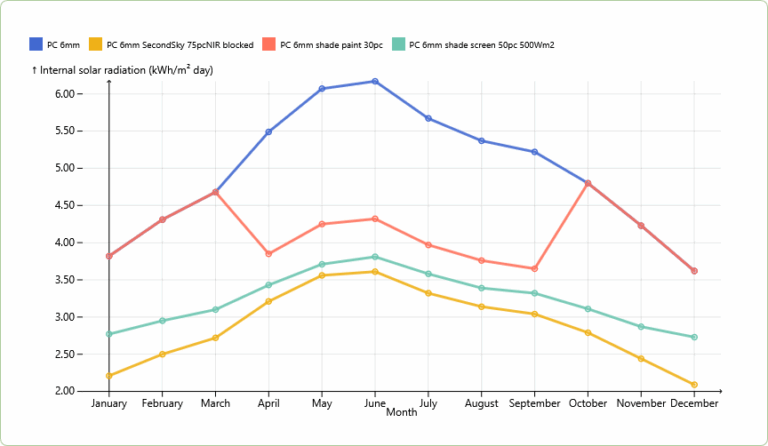

The objective was to simulate the greenhouse’s climate performance under the extreme heat and radiation conditions typical of Abu Dhabi’s hot climate. With the support of a greenhouse design cooling consultant, these advanced models make it possible to select the most effective technical solutions based on expected performance, while keeping energy costs under control.
2) Semi-Closed Greenhouse Design in Hot Climates with Guidance from a Greenhouse Design Cooling Consultant
The key features recommended by a greenhouse design cooling consultant for semi-closed greenhouse design in hot climates include a mixing chamber, evaporative cooling system, air distribution tubes, and overpressure control, as shown below.
semi closed greenhouse model includes:
- Climate control set
- Equipments
- Regulation
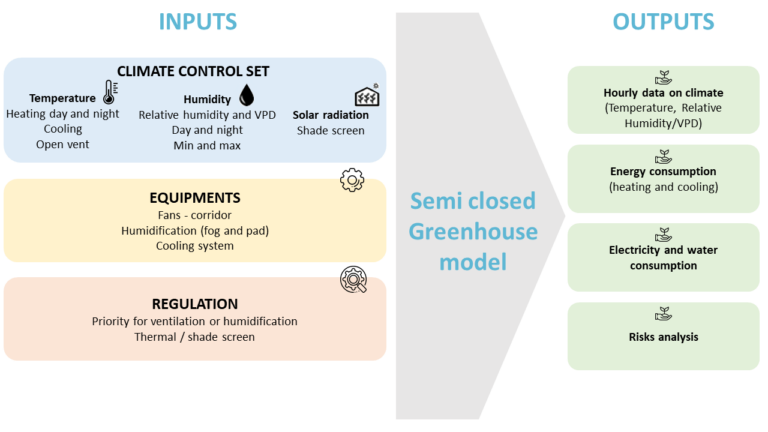
The equipment below can be implemented in the semi closed model:
- Air ventilation in tubes, including electricity energy consumption,
- Controlled external ventilation for dehumidification,
- Air recirculation in tube,
- Evaporative cooling with pad or fog systems.
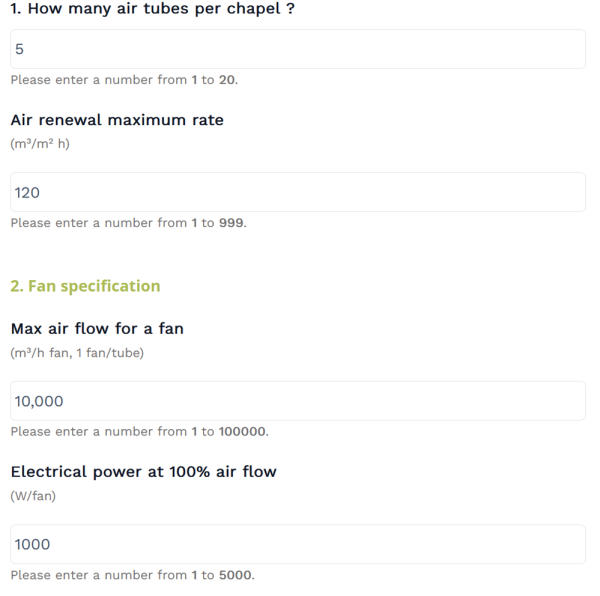
3) Outputs of semi-closed greenhouse design with Greenhouse design cooling consultant
Hortinergy provides a complete analysis of:
- Hourly indoor climate
- Energy, electricity and water consumption.
We present the results for a semi-closed glass greenhouse with pad, located in the south of France. The climate is hot and dry.
Climate settings are:
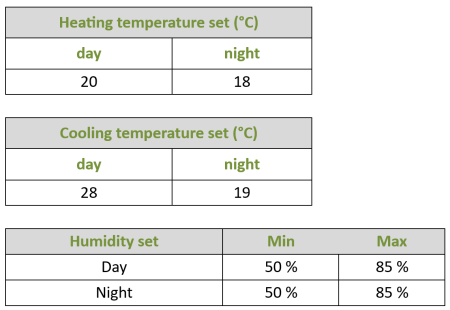
In this example, we are showing the results during a typical day in July.
The indoor temperature never exceeds 28°C and humidity is less than 85%.
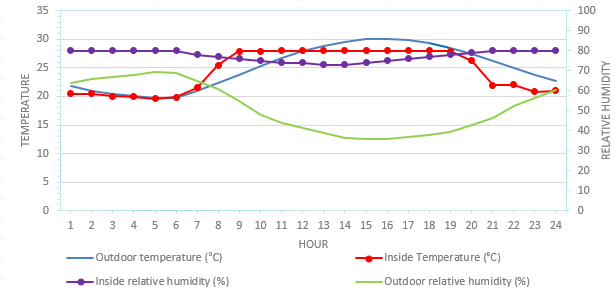
Results also provide the external air flow, water flow and crop transpiration.

At night and in the morning, external air is introduced into the semi-closed greenhouse to dehumidify. During the day, the pad is activated for cooling.
For more information on the semi-closed greenhouse, have a look at this page : semi-closed greenhouse.
With Hortinergy, you can simulate screens, pad and fan, fog system energy consumption, sustainability, cannabis greenhouse, supplemental lighting, and calculate carbon tax rebate. We also provide trainings on energy consumption to become a greenhouse design cooling consultant.