Greenhouse Dehumidification Calculator
Humidity refers to the amount of water vapor present in the air. In closed or semi-closed growing environments, humidity increases due to plant evapotranspiration and soil evaporation, along with the moisture already present in the surrounding air.
Humidity and temperature are closely connected and affect one another, making humidity a key factor in regulating the climate within the growing space. When the air becomes saturated with moisture, it can no longer hold additional water vapor, which may lead to condensation.
Modern greenhouses face increasing challenges in managing humidity. Traditional ventilation methods lead to heat losses and CO₂ dilution, while opening roof vents for dehumidification can account for up to 20% of total heating demand. As greenhouses become more airtight and better insulated, efficient dehumidification is essentia
A greenhouse dehumidification calculator helps you to predict energy consumption
It is used to estimate how much moisture must be removed from the air inside a greenhouse to maintain healthy humidity levels for plant growth. In greenhouse environments, plants naturally release water vapor through a process called transpiration, and irrigation adds even more moisture to the air.
A dehumidification calculator helps growers understand the daily or hourly moisture load, the amount of water vapor in the air, and determines how much of it needs to be removed to maintain a stable, healthy growing environment.
Effective humidity control allows growers to:
-
Keep vents closed for longer periods
-
Use thermal screens more efficiently
-
Reduce energy consumption
-
Improve plant health and disease control
-
Maintain more stable CO₂ levels
Benefits of a Dehumidification Calculator
Energy Savings
optimized thermal performance, helping to lower energy consumption significantly when compared to traditional greenhouse heating methods.
Consistent Climate Uniformity
ensures warmth is dispersed consistently across the entire area, maintaining a uniform temperature from end to end.
Disease Prevention
By stabilizing temperatures and reducing cold spots or excess moisture, it contributes to a healthier environment thus minimizing the risk of plant stress and disease.
The 3 Main Types of Greenhouse Dehumidification Systems
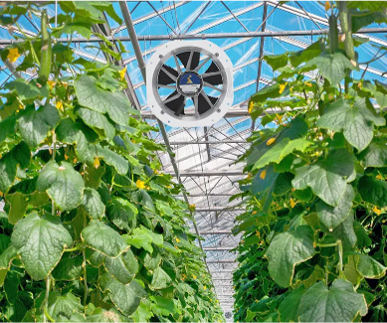
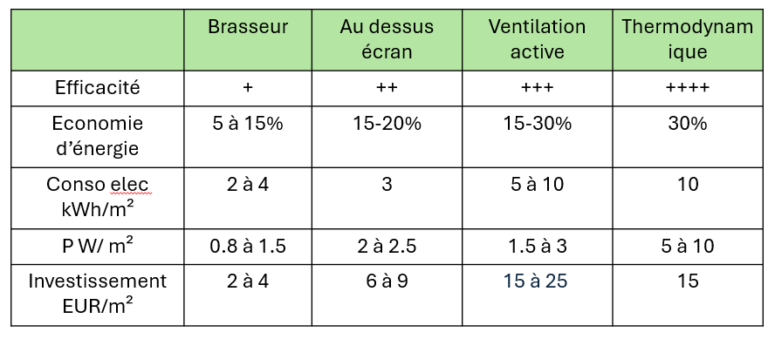
1. Air Circulation Systems (Horizontal Air Fans)
These systems improve air movement inside the greenhouse without removing moisture directly.
Key benefits
-
Horizontal climate uniformity
-
Reduced cold and hot spots
-
Faster drying of leaf surfaces (better crop health)
Typical features
-
Low investment cost
-
Low electricity consumption
-
Best used as a complementary system
2. Dehumidification by Dry Air Intake
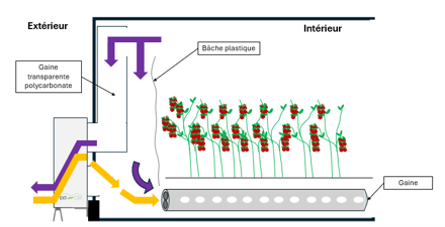
This approach uses outside air, which is often drier in absolute humidity than greenhouse air.
Active Ventilation Systems (AVS)
-
Dehumidification with thermal screens closed
-
Moderate energy savings (10–30%)
-
Limited efficiency during warm, humid nights
Semi-Closed Greenhouses
-
Controlled air intake through a mixing corridor
-
Reduced insect entry
-
High ventilation capacity
-
Suitable for new greenhouse projects
3. Thermodynamic Dehumidifiers
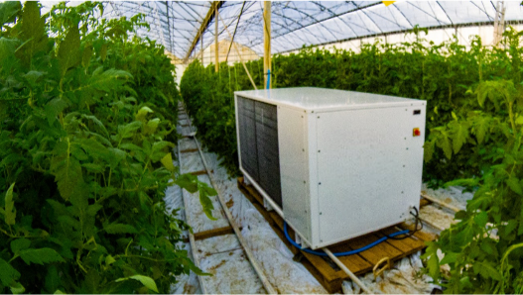
Thermodynamic systems use heat pump technology to condense moisture from the air while simultaneously producing heat.
Key advantages
-
Dehumidification and heating combined
-
High efficiency (2–3 liters of water removed per kWh)
-
Up to 30% heating energy savings
-
Improved CO₂ retention due to closed vents
Important considerations
-
Electrical capacity availability
-
Proper air distribution
-
Minimum operating temperature (>12°C)
-
Smart control to avoid over-drying crops
CO₂ & Energy Performance
Keeping vents closed significantly improves CO₂ efficiency.
-
Without CO₂ injection: CO₂ levels may decrease
-
With CO₂ injection: much higher effectiveness and lower losses
Inputs
Number of dehumidifiers:
Electricity consumption per dehumidifier: (kW or W)
Dehumfication specification at 3 points
Minimum temperature : °C and HR= 80%
Minimum temperature : °C
Water condensated (l/h)
At 18°C and 80%
Water condensated (l/h)
At 25°C and 80%
Water condensated (l/h)
Outputs
- Climated inside Greenhouse (T, HR)
- Electrcity consumption
- Water condensated
- Heat generated
Hortinergy is a greenhouse simulation software developed by Agrithermic with partners like CTIFL, Astredhor, and Agrocampus Ouest. Its climate and energy models, accurate within 10%, have been validated by leading research centers across various climates and greenhouse types. With over 200 users worldwide, Hortinergy is trusted by growers, designers, builders, suppliers, and universities.
Documentation of the Dehumidification calculator: