
Transform your Greenhouse Climate with Pad and Fan Cooling solutions
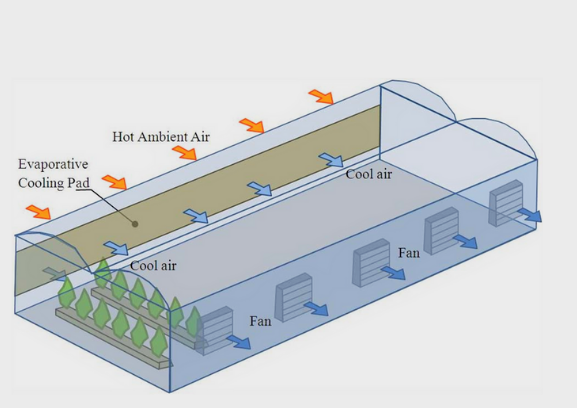
The pad & fan cooling greenhouse system cools down temperature, using evaporative cooling. On hot summer days, this is an efficient way to cool small greenhouses, keeping the plants in the best climatic conditions. In addition, this system uses exhaust fans to absorb air from outside into the greenhouse.
Firstly, the air is blown through the pad, which constantly evaporates water, creating a cooling effect. Then, the fans blow the cool air into the greenhouse, resulting in an overall decrease in temperature.
Some greenhouses need to be cooled at night, mainly in tropical regions. However, the wet pad and fan system may not provide the desired results in tropical regions, where absolute humidity is often high at night.
When outside conditions are humid, pad and fan system will lose its efficiency and provides less cooling capacity. This is because evaporative cooling is based on the difference between outdoor and indoor conditions.
What is Pad & Fan cooling?
Pad and fan cooling is a greenhouse climate-control method that lowers indoor air temperature by evaporating water into incoming outside air. Exhaust fans on one wall pull air through a wetted cellulose or kraft paper cooling pad on the opposite wall. As water evaporates from the pad, it absorbs sensible heat from the airstream, producing a cooler, more humid air mass inside the greenhouse.
How does a Pad & Fan cooling system work?
A pad and fan cooling system relies on four coordinated components and one physical principle: adiabatic evaporative cooling along the wet-bulb depression line.
- Water circulation. A recirculating water system pumps water from a sump up to a distribution header running along the top edge of the cooling pad. Water trickles down through the pad and unevaporated water returns to the sump.
- Wetted cooling pad. Outside air is pulled through a porous cellulose cooling pad (most common) or kraft paper cooling pad. The pad’s large wetted surface area maximizes contact between air and water.
- Evaporation. As outside air passes through the pad, water evaporates into it. The latent heat required for evaporation is drawn from the airstream itself, dropping its dry-bulb temperature toward the outdoor wet-bulb temperature.
- Exhaust fans. Fans mounted on the opposite wall pull the cooled, humidified air across the greenhouse and exhaust the warm air out the far end. Airflow direction is always pad → crop → fan.
- Distribution. A 3 to 5 m/s air velocity across the crop ensures even cooling and replaces the greenhouse volume roughly one to three times per minute.
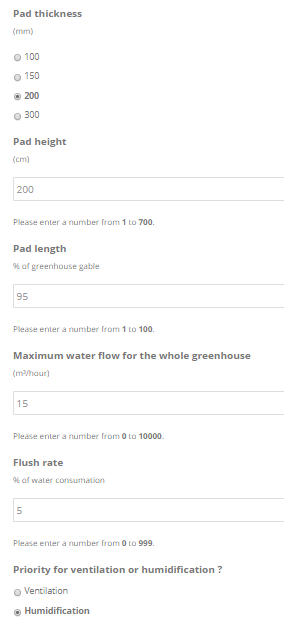
1- What are the Hortinergy parameters to design a pad and fan cooling system?
Some of the pad & fan cooling greenhouse system’s benefits include:
-it keeps the inner temperature of the greenhouse cool at all times, ensuring a lower temperature even during hot periods of the year
-it decreases the temperature and increases the humidity, thereby reducing transpiration of the plants
However, it has also disadvantages:
-the distance between the pad and the fan reflects unequal cooling
-if the system runs constantly, crop growing will be probably uneven
-it is not effective in areas with high humidity (ex: coastal areas)
Pad and fan systems are manufactured by companies such as Munters. For small greenhouse, the cooling box is a good alternative. They are manufactured by companies such as Metmann.
When is Pad & Fan cooling the right choice?
Pad and fan cooling is the right choice when outdoor wet-bulb depression is consistently above 8 °C during peak cooling hours. This rules out humid tropical lowlands (where night-time absolute humidity stays high) and humid coastal climates, but it includes most Mediterranean, continental, and arid zones.
Greenhouse geometry also matters. Pad and fan systems work best when the pad-to-fan distance does not exceed 40 meters: longer runs produce uneven cooling, with the crop nearest the pad significantly cooler than the crop nearest the fans. For longer ranges, consider semi-closed or sealed greenhouse designs with internal recirculation.
2-How to Design an Evaporative Fog System with Pad and Fan to Cool a Greenhouse?
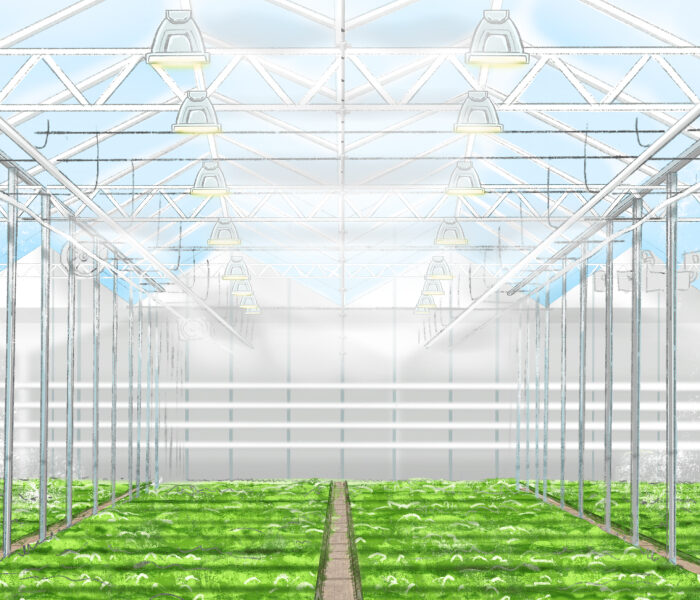
Like the pad & fan cooling greenhouse system, it uses evaporative cooling method to cool down the greenhouse temperature.
Clear water is pushed through a stainless steel nozzle. Then, the water particles are evaporated before reaching the crops. This system works with a pumping unit equiped with a high pressure pump. Nevertheless, it must be installed at the right height, depending on the climate conditions. Lastly, nozzles must be assembled in alternation for a homogeneous coverage.
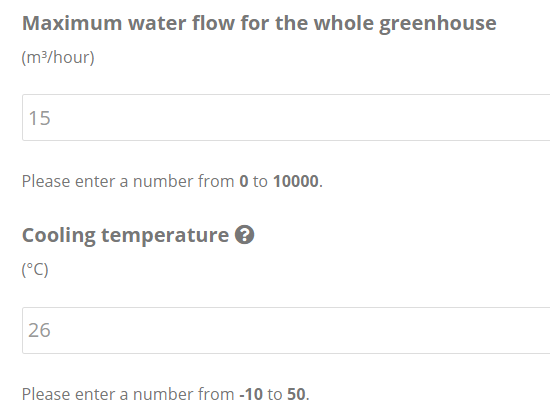
3- What are the Hortinergy parameters used to design a fog cooling system with pad and fan for a greenhouse?
Advantages:
-natural cooling (it regulates temperature to a very large measure in situations where ventilation is not enough, thereby decreasing the inner temperature when needed + less C02 will be lost and more will be available for crop growth).
-minimal water use (due to temperature control and humidification)
-optimal humidity
-small droplets (micron) lead to a higher droplet density
Disadvantages:
-this technology is very dependent on the climate. Indeed, if it is too humid, the system will not work efficiently.
Fog systems are manufactured by firms such as MJTech.
Pad and fan cooling is the most widely deployed evaporative cooling system in low tech greenhouses worldwide. When summer indoor temperatures climb above the crop’s optimum, a properly sized wet wall cooling system can lower indoor air temperature by 5 to 8 °C (10 to 15 °F), keeping plants in their productive range without resorting to mechanical refrigeration. But “properly sized” is the hard part: pad area, airflow, fan static pressure, water flow, and climate all have to align and a mistake on any one of them collapses the saturation efficiency of the whole installation.
Hortinergy lets you simulate a pad and fan cooling system for any greenhouse, anywhere in the world, using hourly weather data, your structure’s real thermal properties, and your crop’s transpiration profile.
How Hortinergy simulates pad and fan cooling
Hortinergy models pad and fan systems using your local hourly weather data over a full reference year. You enter your greenhouse location, structural materials, screens, crop type, and the pad and fan configuration. The software runs an hourly energy and mass balance — including outdoor wet-bulb temperature, pad saturation efficiency, recirculating water system losses, and the fan static pressure curve — and returns the indoor temperature and relative humidity for every hour of the year.
The pad and fan configuration is entered through four parameter groups, designed to match how an engineer actually specifies the system.
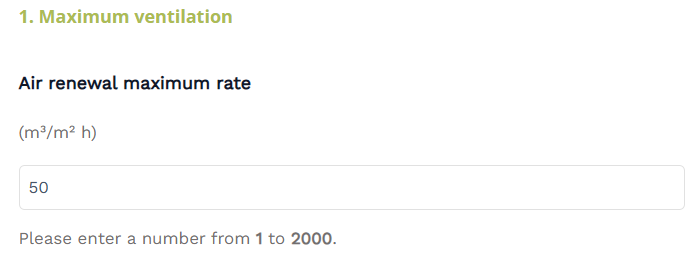
- Maximum ventilation
- Maximum air renewal rate — sets the upper bound on airflow the system can deliver, expressed in air changes per hour. This is the ceiling Hortinergy respects when computing required fan duty at every hour of the year.
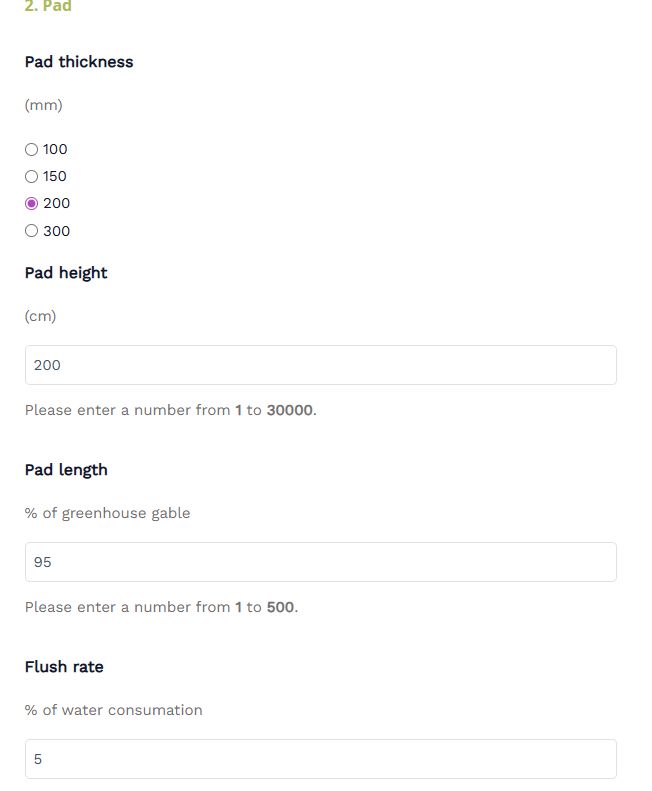
- Pad
- Pad thickness — 4″ or 6″ cellulose are the common choices; thickness drives saturation efficiency (65–75 % at 4″, 75–90 % at 6″).
- Pad height and pad length — together they define the pad face area, which combined with airflow yields the actual face velocity and the resulting pressure drop and efficiency.
- Flush rate — the bleed-water fraction of make-up flow, used to control mineral concentration and scaling in the recirculating water system.
- Maximum water flow for the whole greenhouse — caps the pump duty and feeds the annual water consumption output.
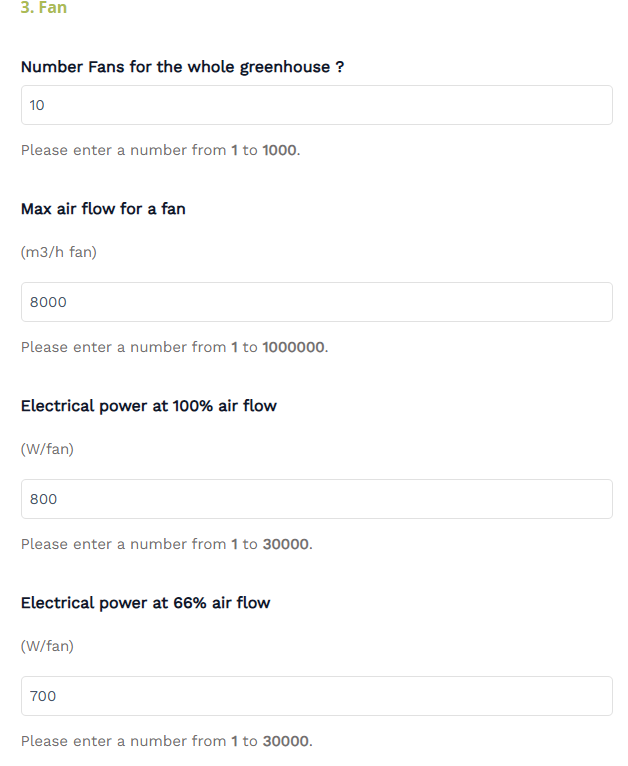
- Fan
- Number of fans and air flow per fan — these set the installed capacity.
Hortinergy stages the fans hour by hour rather than running them at a constant rate. - Electrical power at 100 %, 75 %, 50 %, and 1 % airflow — this part-load curve is what most simulators get wrong. A fan running at 50 % airflow doesn’t consume 50 % of its rated power; modeling the full curve avoids overestimating electricity consumption by 20–40 % during shoulder-season operation.
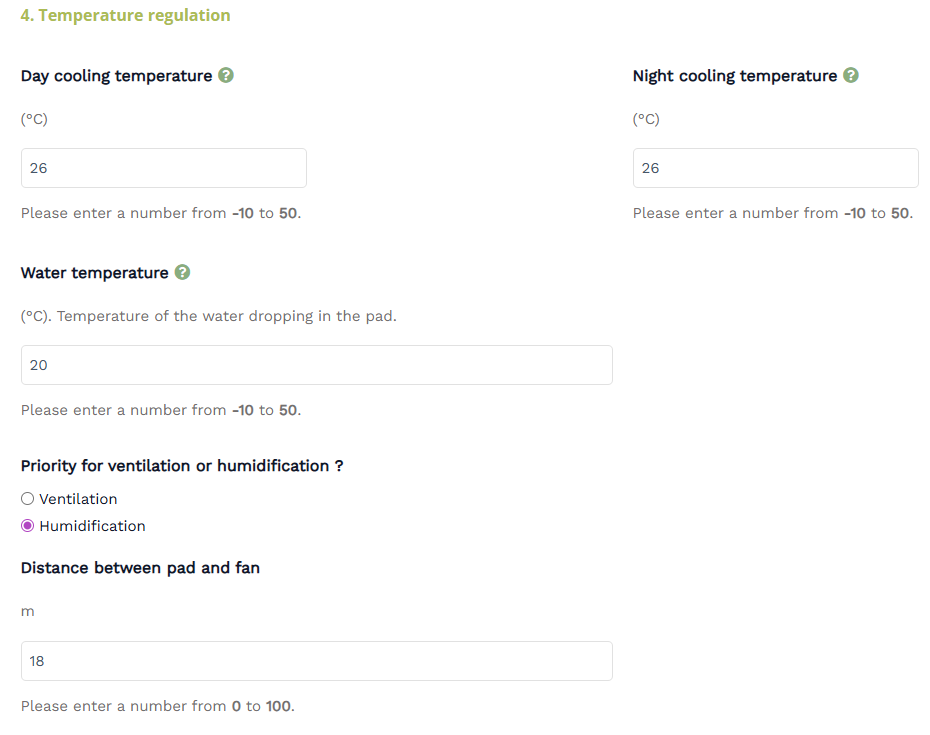
- Temperature regulation
- Cooling temperature setpoint — the indoor temperature above which the system engages.
- Priority for ventilation or humidification — control-logic toggle. When both cooling and humidification reduction are needed, this setting tells the model whether to favor airflow (maximize ΔT) or favor pad wetting.
- Distance between pad and fan — directly drives the longitudinal temperature gradient calculation. Beyond 40 m, the gradient between pad-side and fan-side crop becomes large enough to affect productivity, and Hortinergy quantifies that delta.
The output you see is an annual hourly chart comparing indoor temperature with and without pad and fan cooling, plus monthly water and electricity consumption (computed directly from the part-load fan power curve and the maximum water flow input), and a per-month count of hours outside the crop’s optimum humidity window.
Conclusion
Evaporative cooling systems such as pad & fan or fog are efficient for cooling down greenhouse temperatures. They are well suited for hot & dry areas but not for humid & hot areas.
Pad & fan cooling systems are suitable for greenhouse with a small distance between pad and fan. Fog systems are suitable for any greehouse size but hard water must be treated.
With Hortinergy, you can simulate screens, semi-closed greenhouse, energy consumption, sustainability, cannabis greenhouse , supplemental lighting, and calculate carbon tax rebate. We also provide trainings on energy consumption to become a greenhouse designer.
Hortinergy is an online software. You can choose your offer, create an account and start your project.

With Hortinergy, you can also design cannabis greenhouse with low energy costs and an optimal climate. You can simulate screens, closed greenhouse, supplemental lighting…
Our consulting company Agrithermic can also support you in calculations